- Home
- Who We Are
- What We Do
- Projects
- Chicago Health Atlas
- Illinois Open Technology Challenge
- Civic Innovation in Chicago
- Hosted Web Space
- Developer Resources
- BTOP
- Sustainable Broadband Adoption
- Smart Communities
- Public Computer Centers
- YOUMedia Expansion
- CHA Computer Center Expansion
- CCC Computer Center Expansion
- Digital Skills Initiative
- Connect Chicago
- CTC Connect
- Smart Health Centers
- News
- Archives
Currently viewing the category:
"Civic Innovation in Chicago"
On Saturday, civic web developers, designers, and data gurus came together with the Chicago Police Department at Google’s Chicago headquarters to test out and find creative ways to use the new ClearPath API.
ClearPath is [...]
On Saturday, civic web developers, designers, and data gurus came together with the Chicago Police Department at Google’s Chicago headquarters to test out and find creative ways to use the new ClearPath API.
ClearPath is the Chicago Police Department’s community information portal. First launched in 2007, ClearPath gives residents information not only about crime in their area, but also information about which police beat they’re on and when their CAPS meeting is.
CAPS (Chicago Alternative Policing Program) is Chicago’s community policing program. At the center of this program are the CAPS meetings that occur in each police beat. At the CAPS meetings, the police department can hear about community concerns in the neighborhood and interact with local residents.
With the new API, the Chicago Police Department wants to make it easier for residents to interact with the ClearPath website and to report community concerns. CAPS Executive Director Lucy Moy and CPD Information Services Direction Jonathan Lewin explain:
Results of the Safer Communities Hackathon

Photo Courtesy of Brian Fitzpatrick
The hackathon produced a number of creative ways to use the API to make it easier to interact with CAPS and the ClearPath system.
CAPSure by OpenCity Apps
Derek Eder and the OpenCityteam helped to test the API and got an early start on building an app using the API.
The app they launched is called CAPsure. CAPSure helps residents get information about their local CAPS meeting. You enter in your address and the app will tell you which police beat you are in, when your next CAPS meeting is, and where the meeting is located. The app can also add the meeting to your Outlook, Google, or iCal calendars.
The app uses the ClearPath API’s calendar and event data to find events. The app also uses the City of Chicago’s data sets to help find users police district and beat number.
CAPStagram – Hackathon Winner
Image courtesy of Patrick Brown
The winner of the Hackathon was a team of Patrick Brown, Karl Statz, Donchaa Carroll, and Cathy Deng.
For this concept, the app attaches a picture to community concerns submitted by residents. Currently, the ClearPath API doesn’t allow you to include pictures when making a community concern report. This mobile app allows users to send their local CAPS district a picture of a concern such as an abandoned building or graffiti to help aid in the investigation.
CAPS by Text – Runner Up
The runner-up for the hackathon was the team of Alex Soble, Josh Kalov and Demond Drummer.
Their app prototype allows users to send a community concern to their local CAPS district by text so that residents without the internet could still take advantage of the new system.
CAPs Alerts – Third Place
In third place was an app prototype built by Kevin McMahon. This mobile app not only uses the ClearPath API to help report community concerns, but it will also alert users when crime is reported near them.
Other prototypes:
Other ideas for using the ClearPath API included:
MapThatTrap: An app that residents can use to report abandoned buildings to both 311 and to the ClearPath API
Green Light Program: A concept that would change the colors of Chicago’s Blue Light Cameras from blue to green as crime rates went down in the neighborhood.
Next Steps:
For groups wanting to continue to work on their apps or for people not at the hackathon wanting to get involved, there are some great resources out there to make that happen.
The first is the Chicago OpenGov Hacknight that happens every Tuesday at 6:00pm at 1871. The OpenGov Hack Nights are a great place to learn about what is happening with civic innovation in Chicago and work on civic app projects.
If you’re looking for a place to host your civic app, the Smart Chicago Collaborative provides free hosting to civic applications. Smart Chicago will also provide user testing for your app for free as well.
If civic developers have questions about the API, they can contact the developers directly by emailing API@ChicagoPolice.org
Making our communities safer is an ongoing challenge that will not be solved in a single weekend or by a single web application. To utilize the new API to the fullest extent will require partnerships between the CAPS office, civic technologists, and community groups. If you’re a CAPS group or neighborhood organization that would like to form partnerships with civic technologists, feel free to email cwhitaker @ cct.org for more information.
A big thank you goes out to the Google’s Brian Fitzpatrick for hosting the hackathon, as well as the Chicago Mayor’s Office and Department of Innovation and Technology for putting on the event. A special thanks also goes out to the Chicago Police Department for spending their Saturday with us and their continued service to the City of Chicago.
Tagged with: Public Safety
On May 31st – June 3rd, Chicago will have three separate events in coordination with the National Day of Civic Hacking.
National Day of Civic Hacking is a nationwide effort being coordinated by Random Hacks of Kindness, Code for America and the White House to help organize [...]
On May 31st – June 3rd, Chicago will have three separate events in coordination with the National Day of Civic Hacking.
National Day of Civic Hacking is a nationwide effort being coordinated by Random Hacks of Kindness, Code for America and the White House to help organize civic minded developers, designers, writers, and data scientists help create innovative solutions to civic problems.
This day— the first of its kind in the nation— has been a long time in coming. Back in January, I wrote about what it takes to turn civic hacking into civic innovation. Here’s a snip:
The civic hacking community in Chicago has produced a variety of civic web applications based on open data provided by local government here in Chicago. These apps do things like show economic indicators in fun ways, let you know if your car was towed, and how & where to get a flu shot.
There are lots of reasons why civic hacking works here in Chicago— a rich baseline of data and technology, an engaged developer community, real discussions with government about policy and data, and the support of institutions are all important factors.
But what we’re missing most is sustained engagement with the residents of the city of Chicago. That’s how we can turn mere hacking into real innovation. The magic combination of government, developers, and community members is what we’re after.
So that’s our focus here in Chicago. While cities across the nation participate in the essential baseline tasks of civic hacking, we’ll be tackling this broader work, seeking to expand the movement we’ve built.
It’s time for all Chicagoans to “meet the movement”– to work hand-in-hand with hackers in order to make our communities better. We hope you’ll join us. Here’s a list of events:
ChicagoMigrahack at Cibola (May 31st – June 2nd)
The purpose of Chicago Migrahack is to foster the use of technology and open data to innovate information around immigration. In Spanish, the word “migra” refers to immigration.
We want to bring together our communities to create innovative platforms around one of the most debated topics today: Immigration
This event will kick off Friday, May 31st with a day of training around civic hacking and data. There will be $7,000 in cash prizes given away for the best projects.
Civic Hack Day for Youth at Adler Planetarium
Image courtesy of Greg Briggs – Creative Commons License
The Adler Planetarium is holding a youth-focussed Civic Hack Day on June 1/2 where Chicago youth, mentors, and highly skilled STEM professionals will work together in teams towards solutions to Chicago Issues. Youth team members will bring problems with them that they, or members of their communities, face on a daily basis, as well as a vision for a technological solution. This unique, youth-focused event is being run in collaboration with the Hive Chicago, Mikva Challenge, the Chicago Architecture Foundation and Free Spirit Media Working. Young people, their mentors and STEM professionals will shape and build working prototypes of their solutions over an awe-inspiring 28-hour period.
Hack for Chicago at 1871 (June 1st)
We’ll be having several different events at 1871 during the weekend. You can register for these events here.
App Design Workshop with the Knight Lab
Miranda Mulligan from the Knight Lab will give a workshop on designing apps that meet the needs of users.
National Civic Hacking 101 Workshop with Code for America
Christopher Whitaker will give a short primer on civic hacking to help orient people who are new to hackathons and civic innovation. This class will be broadcast nationwide in cooperation with other cities.
OpenStreetMap Edit-a-thon with Ian Dees
OpenStreetMap is an open source map that anyone can edit. Users can add data to the map including information about their favorite restaurants, cultural venues, and more. We’ll be adding more data to the map all weekend long. You can register for the event at the Chicago OpenStreetMap Meetup Page here.
General Hack Session with OpenCity Apps
We’ll also be having a general hack session if you’re already working on a civic app.
We’ll be sending more information about the event as time gets closer. Look forward to seeing you at one of the events!
OpenGov Hack Night: 1 Year Anniversary
By Christopher Whitaker On April 22, 2013 · In 1871, Big Data, BTOP, Civic Innovation in Chicago, Connect Chicago, News, OpenGov Hack Night, OpenGovChicago
Happy Birthday OpenGov Hack Night!
This week was the one year anniversary of the Chicago OpenGov Hack Night.
The Year in Review (6:30)
Some quick stats on what’s gone on in the past year.
48 Hack Nights 7 Data Potlucks 98 Lou Malnati’s Pizzas 300 [...]
Happy Birthday OpenGov Hack Night!
This week was the one year anniversary of the Chicago OpenGov Hack Night.
The Year in Review (6:30)
Some quick stats on what’s gone on in the past year.
- 48 Hack Nights
- 7 Data Potlucks
- 98 Lou Malnati’s Pizzas
- 300 unique attendees from 15 cities
- 24 civic apps (just out of the hack nights)
Chicago’s OpenGov Hack Night has been around for a year!
Congrats guys!
The City of Chicago and the Broadband Technology opportunities Grant

Francesca Rodriquez and Danielle DuMerer gave a presentation on the city’s efforts to close the digital divide.
The City of Chicago was one of the few major cities to receive a Broadband Technology Opportunities Grant. This grant is used to fund a number of projects in Chicago aimed at growing broadband adoption in Chicago.
The City received $16 million in BTOP funds to help build out Public Computing Centers and run comprehensive programs in some of Chicago’s more disadvantaged neighborhoods. In addition, the MacArthur Foundation provided matching funds. LISC Chicago and the Smart Chicago Collaborative partnered with the city to administer the programs.
You can find all the public computing centers that are funded by the grant on WeConnectChicago.org.
EveryoneOn campaign
Chicago’s done a lot of work to close the digital divide and continues to hammer away at the issue with the launch of the EveryoneOn campaign. EveryoneOn is a national program that aims to increase digital literacy and access to the high speed intenet. The program is being piloted in Chicago.
As part of the program, the city is partnering with Connect2Compete. Connect2Compete is a non-profit website where residents can search for affordable internet options near them. Residents simply enter their zip code and answer a few questions in order to see their options.
Previously, the City worked with Comcast to provide low-cost internet as part of the Internet Essentials initiative in 2011. The city has now expanded that option to include FreedomPop.
FreedomPop is a wireless router that uses the CLEAR 4G wireless network. (Smart Chicago is currently testing the devices across the city as part of the Civic User Testing Group.) With the FreedomPop routers, residents can get a gigabyte of free data each month. For $10/month, residents can increase that amount to 10GBs.
The city has made great strides to close the digital divide in the past two years. Here’s some examples of the work that’s gone on. (From the city’s website)
- Establish free Wi-Fi at 28 public computer center sites and upgraded free Wi-Fi at 66 Chicago Public Library branches;
- Provide over 180,000 hours of instructor-led technology training to 29,300 Chicagoans citywide;
- Help at least 570 Chicagoans find jobs through 180,000 one-on-one CyberNavigator assistance sessions at the libraries;
- Deliver technology training to over 1,000 small businesses;
- Provide out-of-school digital media programming to 1,350 youth;
- Establish the Connect Chicago network to bring together over 250 locations that offer free digital skills training throughout the City; and
- Install over 1,400 computer stations at 170 public computer centers citywide, located in CHA facilities, CCC campuses, community centers, libraries and Veterans Resource Centers.
We’re excited to see what comes next.
Juan-Pablo Valez: Lessons on civic hacking (25:35)
Juan-Pablo Valez presented his thoughts on how we can get citizens involved in civic hacking.
Juan used a number of examples to help explain the process of civic hacking and how citizens can get involved.
Lesson One: It needs to solve a problem – Flu Shot App
The City’s health department distributes free flu shots every year to help keep Chicago healthy. This year the city heavily advertised on CTA to encourage residents to get a flu shot. However, it wasn’t always easy to find where to get a flu shot.

More civic hackers hard at work
Working with the city’s health department, Tom Kompare built the flu shot finder app. Once the app was built, it was adopted by the city.
Juan explains, “While the flu shot app won’t solve public health, it does solve a particular civic problem – and that’s good!”
Lesson Two: Discovering the bureaucracy - SecondCityZoning.org
As civic hackers start to work on these projects is that you discover the intricate of the way the city works. Secondcityzoning.org is an OpenCity website that lets you explore Chicago’s different zones. The site also educates people on what the zones actually mean.
Lesson Three: Spreading the word – Schoolcuts.org
The other big lesson is that once an app is built you need to get the word out. Jeanne partnered with Josh Kalov and the Open Data Institute to create a website that helps open up school data in a format easily understandable to parents. By helping to provide guidance to what parents needed, the end result was a site that helps parents and the community understand what’s happening with the school closing in Chicago.
Jean found the groups in Chicago that cared about the school closings and worked with them to help get the word out. Schoolcuts.org has now been featured in several press stories and is one of the most accessed civic apps coming out of Chicago.
LISC Chicago (49:00)
Suzanna Vasquez, Executive Director of LISC Chicago, spoke about their Smart Communities program. Smart Communities works to increase digital access and digital literacy in the Chicago neighborhoods of Auburn Grsham, Chicago Lawn, Englewood, Humbolt Park, and Pilsen. LISC works with local partners to help support local initiatives to close the digital divide. A good example is the work done by Teamwork Englewood. (Who is working to raise funds to increase its Englewood Codes class to 30 students.)
LISC is a semi-finalist for the Knight Foundation News Challenge for their proposal “OpenGov for the rest of us” that hopes to use the same model to help open gov and civic hacking projects in the neighborhoods.
The City of Philadelphia – BTOP Partners and Philly Tech Week (57:55)
OpenGov Hack Night was proud to have Linsey Keck and Ashley Del Bianco as guests at this week’s hack night. They were part of the BTOP conference that was occurring in Chicago this week.
Linsey and Ashley run the BTOP grants in Philadelphia. Philadelphia and Chicago have a lot of similarities in terms of their open data policies, their efforts to close the digital divide and both cities have civic hacking events on a regular basis.
At next weeks Philly Tech Week, the team is running several events aimed at getting people to think about digital access issues. This includes an event designed to get all members of the tech community to talk about how we bridge the gap between the tech world and disadvantaged neighborhoods.
Big Data Week in Chicago (1:07)
Next week is going to be Big Data Week in Chicago. There will be a number of events in the Chicago all during the week with many of these events being streamed online. You can get more information about these events by visiting bigdatachicago.com/chicago.
Edit Your Neighborhood On OpenStreetMap
By Christopher Whitaker On April 19, 2013 · In 1871, Applications, Civic Innovation in Chicago, OpenStreetMap
They’ll be two opportunities for residents to help improve OpenStreetMap. The first is an OpenStreetMap Mapathon designed to help new mappers learn OpenStreetMap.
OpenStreetMap is an open source map that anyone can edit. Users can add data to the map including information about their favorite restaurants, cultural venues, and more.
We took some time out to talk with Ian Dees [...]

They’ll be two opportunities for residents to help improve OpenStreetMap. The first is an OpenStreetMap Mapathon designed to help new mappers learn OpenStreetMap.
OpenStreetMap is an open source map that anyone can edit. Users can add data to the map including information about their favorite restaurants, cultural venues, and more.
We took some time out to talk with Ian Dees to show how easy it is to edit your hood with OpenStreetMap. The video is a quick step-by-step walk-through of how to make edits to the map.
OpenStreetMap can be edited using a free tool called idEditor. The editor will automatically find your location when you sign in. At this point, you can search for a location in the address bar or just explore around the map.
For our example, I had noticed that one of my neighborhood restaurants wasn’t showing on the map.
Using the idEditor, Ian was able to show me how to quickly add information to the building.
If you’d like to help edit your neighborhood, then join us this weekend for the OpenStreetMap Map-a-thon.
The OpenStreetMap Map-a-thon is a national event designed to teach new mappers the tools to improve the OpenStreetMap in your area.
Chicago’s Map-a-thon will be April 20th and 21st at 1871 on the 12th floor of the Merchandise Mart, 222 Merchandise Mart Plaza from noon to 6pm. Food and drinks will be provided by the Smart Chicago Collaborative.
You can RSVP at on the Chicago OpenStreetMap meetup page.
Building civic apps is hard work. There’s data that has to be cleaned up, code to be written, and a host of other problem solving issues that are unique to apps that take on civic challenges. Often, these apps are built on a volunteer basis during people’s free time.
Chicago has been at the forefront of civic app development. We’ve had our apps redeployed to cities like Boston, Phillidelphia and Oakland. Chicago’s civic development community has been featured in publications like TechPresident, Atlantic Cities, and Computer World. We’ve seen our apps presented on the air and on television.
It’s been a lot of work.
So, we’re excited that BuiltinChicago is adding a new Moxie Award catagory: Best Civic App.
The Moxie Awards are a celebration of Chicago’s startup community with awards going to startups, venture capitalists, mentors, and CTOs.
This year, BuiltinChicago has added four more award categories including Best Civic App. The category was started after a suggestion from Marty Malone who had been interning with the Chicago Department of Innovation and Technology last year.
Any civic app that uses government data to solve civic problems is eligible for a nomination. We know it’s going to be hard to pick a favorite, so you can nominate more than one app. Which is great news since there are over sixty civic apps! (You can see a list of all the apps here - Note that there are probably many more than are on this list.) Anyone can nominate a civic app by filling out a nomination form at the Moxie Awards website. Final award winners will be selected by a combination of 50% public votes and 50% judges’ votes.
The Moxie Awards will take place June 20th at Park West in Chicago. Tickets will be made available for purchase soon.
Did you know, Civic apps can get free hosting and user testing?
While we’re on the subject of civic apps, the Smart Chicago Collaborative offers free hosting on our Amazon AWS cloud servers as well as Heroku servers. Any app that uses open government data and helps to improve the citizen experiance is eligible for hosting. To get more details, you can fill out an interest form here.
The Smart Chicago Collaborative also offers free user testing to civic developers. The Civic User Testing Group is comprised of volunteer testers from all over the city. To have your app tested, simply fill out the interest form here.
Data Potluck: 7 Million Rows of Data
By Christopher Whitaker On April 2, 2013 · In 1871, Big Data, City of Chicago, Civic Innovation in Chicago
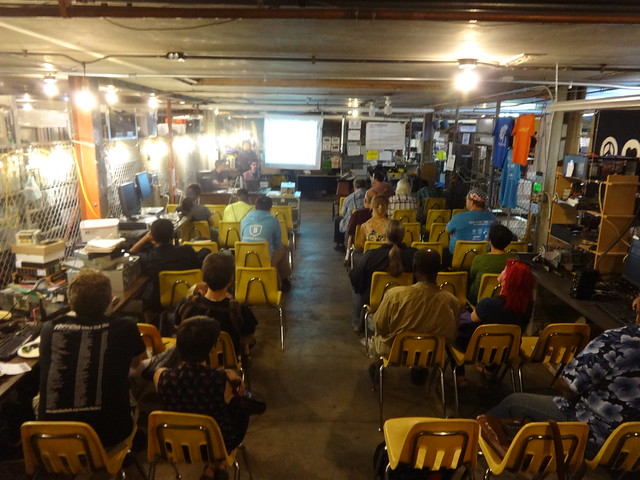
There were a lot of people at this week’s data potluck
Data Potluck is a monthly event occurring the last Tuesday of every month at 6:00pm inside 1871. Like the OpenGov Hack nights, these events focus on how open data and civic apps can help improve the citizen experience. However, [...]
There were a lot of people at this week’s data potluck
Data Potluck is a monthly event occurring the last Tuesday of every month at 6:00pm inside 1871. Like the OpenGov Hack nights, these events focus on how open data and civic apps can help improve the citizen experience. However, these events have a more non-profit focus to them. Data Potluck was inspired by last year’s DataKind Data Drive which helped gather data for the Chicago area Red Cross. In order to keep the effort moving forward, Young-Jin Kim, Matt Gee and Nicholas Mader started the DataPotluck Meetup group.
DataPotluck’s other advantage? People bring food.
Rayid Ghani, Chief Scientist for Obama for America
At this month’s Data Potluck we had two presentations. The first was from Rayid Ghani, former Chief Scientist for the Obama for America 2012 Campaign. Rayid explained how the Obama for America campaign used the power of predictive analysis and social media to help win the election.
Rayid announced that the same model that made the Obama team so effective at their outreach efforts would be made available to non-profits.
Historical Traffic Congestion Data
The second presentation was by the City of Chicago’s Chief Analytics officer to announce the release of a seven million row dataset. Chicago has just released data on traffic congestion by segment.
To get an idea of just how big this data set is, a traffic segment is about a half mile. The city has 300 miles of road that the city keeps real-time traffic data for. The city refreshes the database that lives on the portal every ten minutes.
The city first released the real-time data in December, but civic developers wanted to take a look at historical data.
So, the city worked with Socrata to enable the city’s data portal to be able to handle such a massive volume of data. Now, civic developers can dig into all of the Chicago’s traffic data.
To help developers dig into the data, they’ve created a very well documented API.
This documentation includes code samples in multiple languages on how to access the data as well as definitions on all the different fields in the data set and the possible errors you could get.
Now that this data has been released, we’re excited to see what cool, useful, and interesting things that people will do with this data.
If you want to work with civic data:
For people who are interested in working with civic data, there are two opportunities that they should look into.
The first is the Chicago Data Science Fellowship. The University of Chicago and Argonne National Laboratory are recruiting people with statistics, programming, and data skills to work with real world data to make an impact on social issues.
The second is that the City of Chicago is hiring a data scientist to help ensure that Chicago becomes the very best civic data team in the world. The City of Chicago is looking to hire a new data scientist to join their team. If you are interested, you should apply on the city’s website.
This is a weekly feature that will highlight what’s happening at the Chicago OpenGov Hack Night. The Chicago OpenGov Hack Nights are weekly events where technologists and community members come together to work with open data and build tools that improve the civic experience. The events are held at 6:00 pm each Tuesday at
This is a weekly feature that will highlight what’s happening at the Chicago OpenGov Hack Night. The Chicago OpenGov Hack Nights are weekly events where technologists and community members come together to work with open data and build tools that improve the civic experience. The events are held at 6:00 pm each Tuesday at 1871.
This week’s first presentation: Knight News Challenge Submissions

The deadline for submissions for the Knight News Challenge was on Monday. Civic innovators are competing for their share of $5 million dollars that the Knight Foundation will be awarding to projects that help improve the way that citizens get information from their government. (Author’s note: Smart Chicago Collaborative Executive Director Dan O’Neil is on of the readers giving feedback for the Knight Foundation News Challenge. Projects were included in the post solely because they were presented at the hack night and for no other reason.)
Projects who presented at the OpenGov Hack Night included:
Schoolcuts.org / SchoolCircle.org: (4:34)
Their Knight News Entry: SchoolCircle.org engages parents, teachers, students, & community members with data visualizations about their schools made with a combination of publicly available and crowdsourced data. Users will be able to discuss, and advocate for, their school.
Chicago Crash Browser: (5:40)
Their Knight News Entry: Chicago Crash Browser is a new tool needed by planners and engineers to analyze where the Chicago should invest in infrastructure upgrades to eliminate traffic fatalities by 2022, and educate residents & elected officials about transportation safety.
Visible CTA (7:15)
Their Knight News Entry: To give a visual trip on all CTA routes and a bit of a walk in several directions from every stop. To connect a trip with where one could work through the Illinois Department of Employment Security and other government web sites.
Augmenting 311 Systems With Data Sourced From Social Media: (9:00)
Their Knight News Entry: Enhancing Open311 (and 311 systems in general) to accept information captured from social media outlets and filtered via machine learning and human interaction.
WeCountability (10:10)
Their Knight News Entry: WeCountability will flatten a city’s organization so that good ideas can make their ways from the people doing the day-to-day work to the people making the decisions.
Crowdsourcing Building Data: (10:44)
Their Knight News Entry: We will create a smartphone web app/website that community groups will use to share information about buildings that are abandoned or in foreclosure in order to make neighborhoods more stable, make policymaking more effective, and improve vacant building data quality through crowdsourcing.
Closed Loop (12:00)
Their Knight News Entry: A data mining tool that connects the dots between political campaign contributions, lobbying, and legislation – and detects unusual patterns for investigative journalists to look into.
Announcements:
Data Science for Social Good Fellowships (15:10)
This week’s second presentation: Mote.0.Bike (24:14)
School of the Art Institute of Chicago (SAIC) professors Doug Pancoast (Professor of Architecture) and Robb Drinkwater (Professor of Sound) dropped by the OpenGov Hack Night to discuss their project involving bike sensors.

The bike-mountable moto sensors
“The interface reconsidered” was a collaborative course taught by Robb and Doug. They wanted to redefine interface, specifically in the context of the city.
They used an Arduino Micro-Controller combined with a GPS device to help collect data as people biked around the city. The Ardunio device is programmable and can be setup to collect a number of different data points including location, air quality, altitude, light, humidity and more.
Users can upload the data on the project website. The goal is to have multiple users all over the city collect data so that we can learn more about biking in Chicago. The project is being further by Colin Hutton and the site will see improvements over the next few weeks.
Dataset of the Week: Workforce Centers
Datasets don’t have to be big to be important. The City of Chicago has four different workforce centers. The city’s partnered with over 30 different community organizations to provide employment services.
This is a new weekly feature that will highlight what’s happening at the Chicago OpenGov Hack Night. TheChicago OpenGov Hack Nights are weekly events where technologists and community members come together to work with open data and build tools that improve the civic experience. The events, run by Derek Eder and Juan-Pablo Velez, are held at 6:00 [...]
This is a new weekly feature that will highlight what’s happening at the Chicago OpenGov Hack Night. TheChicago OpenGov Hack Nights are weekly events where technologists and community members come together to work with open data and build tools that improve the civic experience. The events, run by Derek Eder and Juan-Pablo Velez, are held at 6:00 pm each Tuesday at 1871. As a founding member of 1871, the Smart Chicago Collaborative is proud to be able to provide space for this each week.
This Week’s Presentation: GoToSchool by Tom Kompare
This week’s presentation is from Tom Kompare and his current app-in-progress GoToSchool. The app is help parents find directions to their kids school during those first few chaotic weeks. Tom is currently building the app hoping to have it released by the start of the next school year.
To use it, simply find your school by typing in the search bar. The app will try and help you by pulling up matching schools as you search. Once you select your school, you can state when you want to be there. Do you need to grab your kids after work? Plan for tomorrow morning? After you state when you need to be there, the app gives you three options on how you want to get there: walking, CTA/Metra, or by driving. It even gives you the number to call in case your kid is sick and can’t be at school.
The app is hosted on the Smart Chicago Collaborative servers and will be one of the first apps taking part in Civic User Testing.
Here’s how it works:
- The site also uses Twitter bootstrap to make building the appearance of the app easier.
- Tom used two separate data sets from CPS and placed those into Google Fusion Tables. The first is the school schedule and the second is school location data.
- Transit directions are delivered through the Google Places API
Current Issues:
The app is still in development and has a couple of issues.
- The data for start and end times for charter schools in incomplete
- The “What time do you want to arrive” doesn’t look as good in Internet Explorer
Civic Developers and Designers! You Can Help Improve this app!
- You can check out the app and submit pull request on the apps’ GitHub repository.
Dataset of the Week: Business License Data
This weeks’ dataset of the week is business license data. See that new construction across from your work? You can use the city’s business license data to pull up information on what is going into it. The city’s also built views that sort the data into different categories. For example, they have a view of the data that filters out everything but liquor licenses. You can turn that view into a heat map that where they are.
Socrata has a number of features that make exploring and viewing data easier. Once you register with the data.cityofchicago.org site you can make your own views and save them for later use.
Join us!
Are you interested in open data and civic innovation? Have something cool you’d like to show us? Register for the next OpenGov Hack Night here!
Here’s this week’s recap of OpenGov Hack Night Chicago:
This week we live streamed the presentations due to the weather and the CTA Brown line trains not running through the loop.
This week’s first presentation: The Illinois Department of Employment Security and IllinoisJobsLink.com
Gideon Blustein from the [...]
Here’s this week’s recap of OpenGov Hack Night Chicago:
This week we live streamed the presentations due to the weather and the CTA Brown line trains not running through the loop.
This week’s first presentation: The Illinois Department of Employment Security and IllinoisJobsLink.com
Gideon Blustein from the Illinois Department of Employment Security dropped by the OpenGov Hack night to talk about employment data available on IllinoisJobLink. IllinoisJobLink is the State of Illinois’ job board designed to help match employers and job seekers.
The Illinois Employment of Employment Security publishes real time labor market information on hiring trends, salary trends, job seeker characteristics, and current labor availability.
The department is currently open to releasing data in new ways or new reports if possible. Currently, the department also released a limited number of reports on the state’s data portal.
People who are interested in working with this kind of data are encouraged to attend our open gov hack nights.
This week’s second presentation: The Sunlight Foundation and local government transparency
The Sunlight Foundation is a non-profit non-partisan organization dedicated to making government more transparent. Previously, the Sunlight Foundation mainly focused on federal transparency. This resulted in reports on government spending, APIs that help automate reports on government spending, lobbying funds, and congressional action, as well as cool apps like Inbox Influence, Scout, and other transparency tools.
This year, the Sunlight Foundation received a $2.1 million dollar grant from Google.org to help fund transparecy efforts at the municipal level.
In order to get a better idea on how this can be accomplished, the Sunlight Foundation is visiting Chicago and other cities to see what work has been done in this area locally.
Part of this work includes building a living document of open data policy guidelines. This Sunlight Foundation would like to see the open data community get involved in helping to craft these guidelines. Where do we need to expand these guidelines? Where do we need case studies? What fits and what doesn’t? What do you need to work better?
If you’re interested in helping Sunlight with this effort, feel free email the Sunlight Foundation at local@sunlightfoundation.com.
Next week’s OpenGov Hack Night will be March 12th at 6:00pm at 1871 Chicago. You can RSVP here.
If you missed Tuesday’s OpenGov Meeting, the recording is below. Later today, we’ll be putting together a more comprehensive recap of the meeting.
And here’s my writeup:
On a snowy slushy night in Chicago, civic minded web developers, designers, journalists, and advocates gathered at the Chicago Community Trust [...]
If you missed Tuesday’s OpenGov Meeting, the recording is below. Later today, we’ll be putting together a more comprehensive recap of the meeting.
And here’s my writeup:
On a snowy slushy night in Chicago, civic minded web developers, designers, journalists, and advocates gathered at the Chicago Community Trust to hear about the latest developments of the local civic innovation scene.
You can watch the entire presentation here.
http://www.youtube.com/watch?v=3wMpHZs0F7k&feature=g-user-u
The YouTube video description has been marked at different speakers for your convenience.
First up was Chicago’s Director of Analytics Tom Schenk Jr. who had a number of important announcements.
Chicago named a finalist in the Bloomberg Philanthropies Mayor’s Challenge
http://youtu.be/XSNq7Wg_PxA
The Bloomberg Philanthropies Challenge is a contest where cities submit ideas to compete for a grand prize of $5 million dollars. Chicago’s application to to develop a real time predictive analysis platform.
To help Chicago win this challenge, go to http://bit.ly/VoteChiData and vote for Chicago.
Project Falcon
Chicago’s Department of Innovation and Technology is also working on Project Falcon. Project Falcon is an API that’s focused on time and place of events. Once this is online, data scientists will have a strong tool for spatial analysis.
Project Batman
Project Batman is the name for the city’s project using the University of Chicago’s 3D Cave2 system for data visualization.
What is CAVE2? This is CAVE2:
http://www.youtube.com/watch?v=d5XDbzy7vuE
The city will be using this tool to explore data in a brand new way.
City now hiring data scientists
Tom also announced that the City of Chicago is hiring a new data scientist to help harness city data into ways that can improve the lives of citizens. (And get to work with CAVE2!)
Knight Lab: Miranda Mulligan and Joe Germuska
Next up, was Miranda Mulligan and Joe Germuska to talk about the Knight Lab at Northwestern University. (You can find their presentation slides here)
The Knight Lab helps to develop tools for journalists such as Timeline, Local Angle, and SoundCite. Joe gave us a primer on open government data and journalism, drawing on his experience at the Chicago Tribune News Apps team and at the Knight Lab.
WBEZ
WBEZ’s Matthew Green gave a short talk about their efforts to improve data journalism and the station featuring data stories. You can see some of their coverage in WBEZ’s new blog Day X Datum.
John Bracken: Knight News Challenge
The Knight News Challenge is a contest where innovative ideas to improve the citizen experience compete for a share of $5 million dollars in grant money.
Currently, the contest in the submission phase which ends March 18th. After the submission phase is the feedback phase. People will be able to applaud and comment on proposals. The Knight Foundation has tapped eight experts (Including our own Dan O’Neil) to give feedback on each proposal. After the feedback phase, authors will then be able to alter their proposals before the judging phase.
You can check out current submission by visiting the challenge website.
Recently
- Using the new ClearPath API to help communities interact with the Chicago Police Department
- OpenGov Hack Night: Karen Weigert and the CleanWeb Challenge
- Join us for the National Day of Civic Hacking in Chicago
- Join the CUTGroup and Take Part in Test of a Travel-to-School Website
- Foodborne Chicago on WBEZ Chicago
- This Week’s OpenGov Hack Night: App Design Workshop with Knight Lab’s Miranda Mulligan
- The Chicago Police API, Safer Communities Hackathon, and Huge List of Chicago Crime Data Resources
- OpenGov Hack Night: Upcoming Events and Sustainable Data
- Behind the Scenes: Foodborne Chicago
- Big Data Week: Video Analytics in the Wild Panel Livestream